

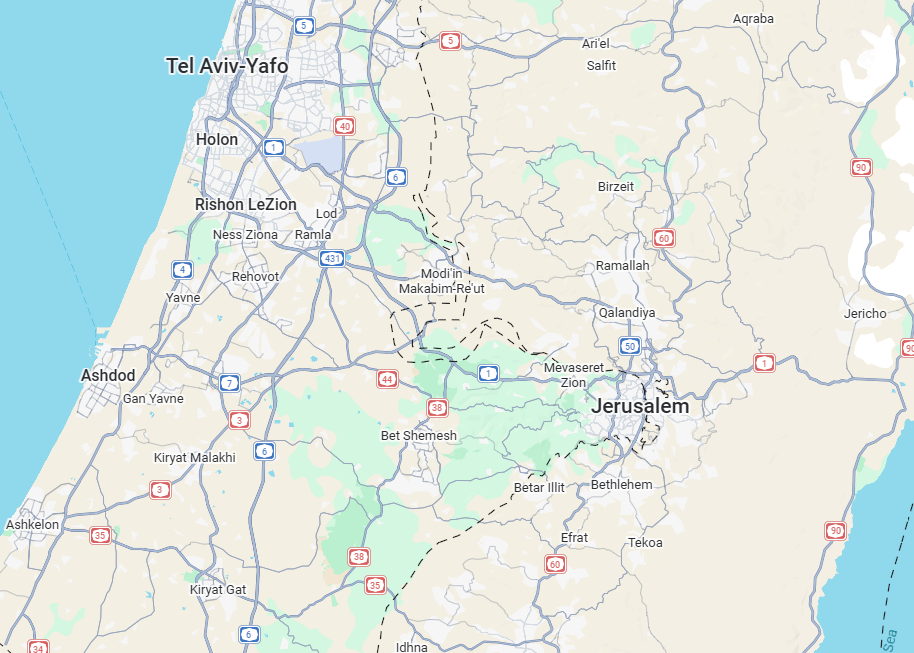
“Palestine.” Map. Google Maps. Google, 31 Oct 2018. Web. 31 Oct. 20218
Palestine
Palestine is pronounced “FilasTeen” in Arabic and is strategically located on the eastern shore of the Mediterranean Sea. For centuries it has been the place of territorial disputes and has survived battles, conquests, crusades, mandates, partitions, and world wars.
A historical land of heritage and culture, Palestine has always been at the forefront of fashion and design. Palestinian attire for women differs depending on the occasion. For instance, velvet is the cloth of choice at weddings especially if one is related to the groom or groom’s family. Metallic thread known as “qasab” is then stitched onto the fabric by using a sewing machine . The seamstress can be well known for the exemplary patterns and color palettes she chooses to demonstrate. This is especially true in the Ramallah area.
Cultural Clothing Spotlight: The Kufiya
The kufyyah/kuffia/keffiyeh (can be written in different ways) can be called by different names in different Arab regions – such as shmagh/shemagh, ghutra, or hatta.
The kufiya is linked to Palestinian livelihood, tradition, heritage, customs, and fashion similar to Palestinian thawbs/thobs (meaning dress.) After the Nakba, the catastrophe, in which Palestinians were uprooted from their land, it became associated with Palestinians’ sense of belonging and survival as a displaced population against attempts to conceal their existence as a group and nation. Across the globe, the kufiya is known as a symbol of solidarity with the Palestinian cause.
The kufiya has social and environmental connotations. In Palestine, historically it was worn by Palestinian Fellaheen/villagers/peasants – and fishermen on the east coast of the country – because it kept them warm in winter and protected them from the sun in summer while tending their lands and crops. When harvesting and sowing wheat and other crops, the kufiya is used to protect the mouth and eyes from dust, dirt, and sand. It is also used to wipe sweat while working on the land. The design represents olive tree patterns, as olive trees are a major crop in many regions in Palestine and many Palestinians rely on them for their livelihood. The olive trees have been passed from one generation to another for centuries. The pattern is also a fishnet connected to Palestinian people on the east coast, whose main way of life is fishing. The third meaning of the kufiya is represented by its bold pattern, standing for the trade route and strategic location of Palestine.
It is also an expression of identity across the Arab world and most Arab countries/regions adopt their own version of it, so differences in colors and patterns are representative of regional and national differences. It is usually made of white cotton; the checkered pattern in red is usually associated with Jordan and Gulf countries while black is associated with Palestine, Lebanon, Egypt, and Syria. Arabs across the Middle East link the kufiya to their long history in the region. For people from Arab countries, it has meanings and emotions that represent local and regional identity.
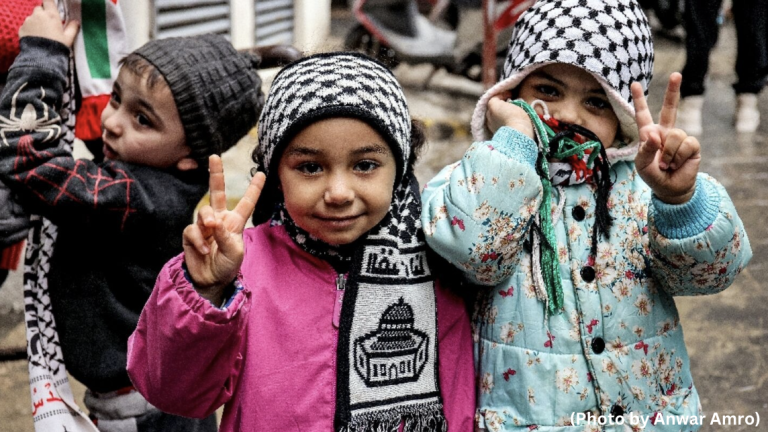
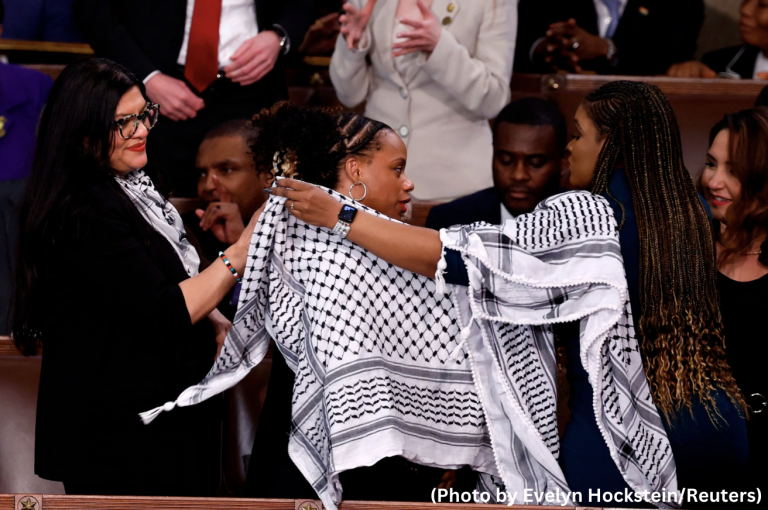
It is now a fashion statement that symbolizes cultural significance and resistance against attempts at cultural appropriation.
It is a clear statement that we exist as a nation. The surged use of kufiya and other Palestinian cultural clothing is related to attempts to revive and re-envision cultural clothes that have become linked to national identity and survival. The Palestinian dress, for example, is an embodiment of de-colonial activism led by women (and some men) who revitalize and popularize it by recreating it in different forms of fashion such as straps for cameras, women’s pages and purses, hair ties, shawls, shirts, dresses… etc. It symbolizes connection to the land and connection among Palestinians scattered around the world.
Because it represents the history, existence, and sense of belonging of Palestinians, and it is a clear symbol of resistance to all attempts of oppression and concealment of identity, its use infiltrates the occupier and its supporters, and therefore, Palestinians are attacked even for presenting themselves through this scarf, the kufiya. Palestinians – including Palestinian students on campuses – are targeted with hate crimes because of simply wearing a kufiya that represents their identity as Palestinians.
Palestinians wear it with a sense of pride. They are targeted simply because they are Palestinians, and using the kufiya to stress their identity might irritate Zionists and white supremacists. Palestinians wear the kufiya and cultural clothes at weddings, special occasions, and in protesting oppression and occupation. They wear it daily to stress their belonging and existence against all sorts of concealments.
– Dr. Enaya Othman
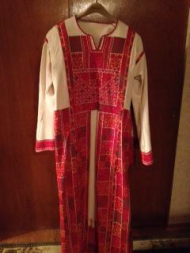
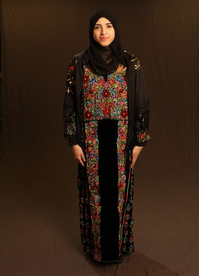
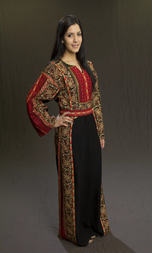
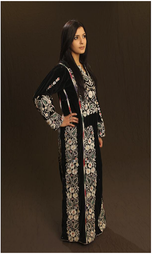
Cross stitching is also a fundamental stitch in Palestinian culture and attire. For ages, cross stitching has been a vital component in Palestinian attire. One amazing aspect of Palestinian dress is that each town or village embraces a certain style that distinguishes one village from a neighboring village. Certain colors and /or cross stitch designs can be significant to one village and not the next. So much so that a woman may be recognized for the village she is from simply by the dress she wears.
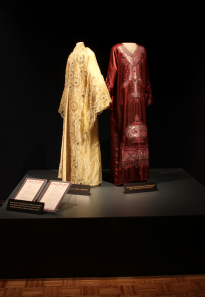
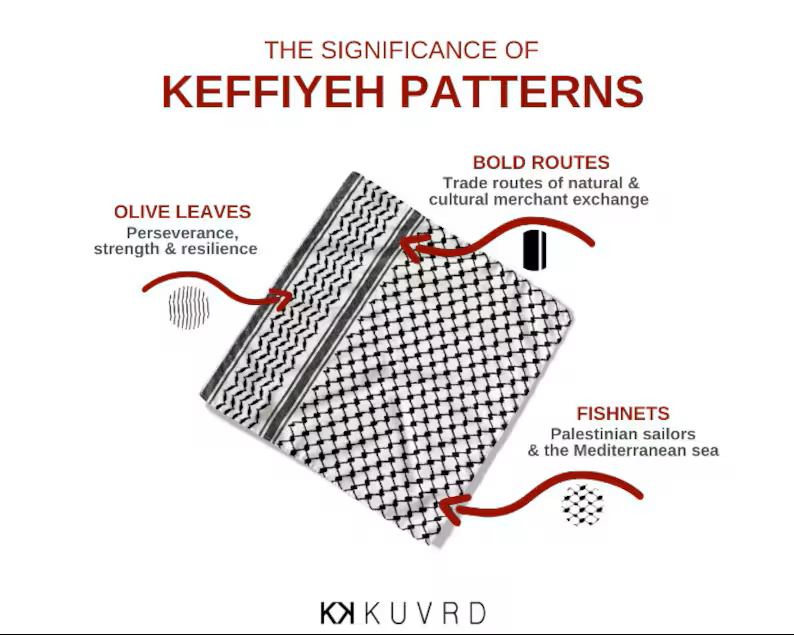
Adapted from KUVRD
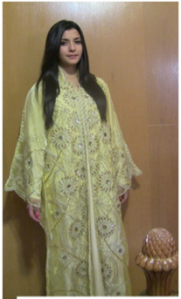
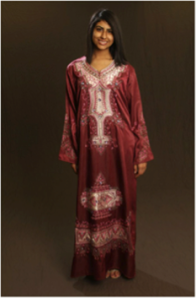
“Annole” is another method of sewing where thread is looped and stiched into specific shapes and patterns.This type is also prominent in the Ramallah area.
Our Stories
One immigrant shares her personal experience with us as she narrates her story of growing up in Palestine and then marrying and immigrating to the US. She shares with us her hopes and dreams for her family and for herself as she evolves into a wife and mother and eventually returns to visit Palestine.
Another immigrant, Ibtisam A. shares with us her personal narrative and pictures of this garment that was made by her grandmother as a gift. We can see that this white and blue needle point creation is cross stitched with blue thread in a traditional checker box pattern onto white, cotton-based material. The pattern was then filled with silk thread according to natural floral envisages which have been handed down from one generation to another. Creating such cultural gowns proved to be a laborious task, therefore many members of a family shared in its construction. This particular gown was produced as a wedding gift from a grandmother to a granddaughter, welcoming her into womanhood. The rich floral pattern exemplifies the religious, Islamic standards to which such attires are bound. The pattern and style of the gown displays that which can be identified with the outlying farming areas of Ramallah, from what is known as Silwad.
Aminah Hamdan
Aminah is a second generation Palestinian American born and raised in Milwaukee.Aminah Hamdan As a second generation Arab she likes to wear traditional clothing to show her Arab culture because it represents who she is and where she comes from. Aminah mostly wears a’bayas and thobes on religious holidays. She also dresses up in them when attending wedding celebrations Her mother influenced her decision to wear cultural clothing. She states that as she was growing up she saw her mom wearing them to parties and celebrations, this sparked and interest in wearing them herself. Aminah purchases her own dresses from either Jordan or the United Arab Emirates. When her mother travels to Palestine and back , she will bring thobes , abayas and dashadish with her for Aminah and her sisters. Aminah is a mother too and she would like to pass down this tradition of wearing cultural clothing to her daughter.
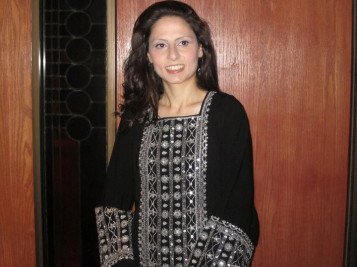
Afaf Abdallah
Afaf is a first-generation Palestinian woman who immigrated to the US in 1975. Cultural clothing means a lot to her which is the reason she owns many thobes, dashadish, and abayas that are originally made in Palestine. Afaf states that she does not wear her cultural clothing on a daily basis, but rather to special events. She stated, “like with the thobe, I wear it for special occasions like weddings and stuff. The abaya and dishdasha I wear it when we have functions at the Islamic Center.” When asked how she felt when she wore her cultural clothing Afaf says, “I feel proud and comfortable! Yeah, I like wearing them!” She believes that she has to keep her culture with her at all times and wearing the cultural clothing allows her to do so. Afaf’s mother had significant influence in her wearing cultural clothing, and when her mother passed away, she passed on many pieces of cultural clothing down to her. Afaf feels as if these garments not only connect her to her mother whom she misses dearly, but also to her Palestinian heritage. When asked what these pieces of clothing meant to her, she responded,
“Well it means a whole lot to me because that is our culture. It makes me remember my roots and culture, the way we were raised. They make me proud not to forget all about that stuff.”
Afaf thinks it is important to pass on her cultural clothing to her daughter and daughter-in-laws because she believes this will carry on the Palestinian culture and allow them to pass it on to her grandchildren.
Riham Hamdan
Riham is a second generation Palestinian American who grew up in the Milwaukee area and is currently raising her three children in Milwaukee, too. Riham has a collection of dashadish and thobes that she enjoys wearing to hennas, weddings and special days such as Eid. These traditional dresses provide her with a strong link to her Palestinian culture and remind her of her grandmother who would sew every stitch by hand. Riham recognizes that the dresses continue to change over time and that “they are more modernized, the beads on them,” while Riham’s mother’s dresses are “more plain.” Riham gets her traditional dresses from her mother who buys them from Amman and Kuwait. Riham hopes to pass down these traditional dresses to her own daughter, Nora.
Salam
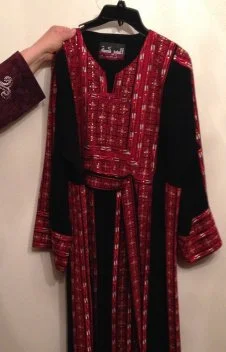
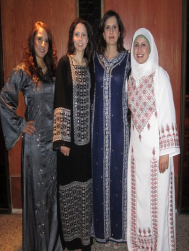
Salam is a first-generation Palestinian woman who settled in the Milwaukee area in 1973. She and her husband have eight children who are all grown and they both enjoy spending time with their grandchildren. Salam enjoys wearing the jilbab, and the thobe during holidays and when she attends prayer at the Islamic Center. When she wears them, Salam says,
“I feel happy because it’s my culture, my tradition.”
They are important to her not only because of their cultural value but also because she feels comfortable and content when she dresses modestly. Salam remembers her mother wearing traditional dresses when she was a child, and although she did not receive any from her mother, Salam purchases dresses for her children and grandchildren during her occasional trips to Palestine. She purchases them not only to show her family how to dress but also to teach them about their history and their culture.
Fatimah Ayesh
Fatima is a first generation immigrant from Palestine who traveled to the United States in 1987 with her husband to start a family of her own. While seeking economic prosperity in the United States, language became a barrier for Fatimah and her husband so she immediately became motivated to learn English. Fatimah’s tenacity to become educated soon transferred to her children. She strives to motivate and instill the importance of education to her children. Fatimah believes that education is a fundamental building block, and when supplemented with life experiences, can serve as an instrument that adequately dissolves ignorance and promotes empathy and understanding between cultures and religions. In regards to tradition and culture, Fatimah states that it is a very important aspect in her life. Fatimah states that in Palestinian weddings the bride wears the universal white wedding dress. However, the night before the wedding is called the Henna and that is a day where the bride dresses in traditional Palestinian attire. Fatimah expresses, “we wear traditional clothes and they use henna, you know henna, they decorate their hands and make it fun for everybody!”
Randa
Randa is a forty-five-year-old female from Jerusalem, Palestine. She is Muslim and considers religion to be a very important factor in her life, so much so that she encourages her children to participate regularly at the local mosque and attend community events that are held there. Randa loves living in the United States, but she often feels nostalgic towards Palestine. Randa states that when she goes back to visit her family and friends, she is more comfortable in terms of dress while she is there because everyone around her wears a similar type of clothing and dresses modestly, whereas in the United States there would be times where she feels that she does not fit in because of the clothing she wears. “The most important thing is to cover my hair,” she says, directing attention to her hijab. Cultural clothing is of great importance to Randa, and she expresses that her mother and grandmother wear traditional Palestinian clothing on a daily basis. Randa states, “it’s a long dress with too much work on it, it’s very nice!” The cultural clothing is usually handmade using various cross stitch patterns and can be any color. Randa owns many pieces of traditional clothing because she believes it is important. She purchases them from overseas or from a shop in Chicago and she wears these timeless pieces to weddings and special occasions. Randa tells us that she owns a few traditional dresses that were passed down to her from her mother, and she lovingly proclaims that she will pass them on to her daughters at some point to keep the culture alive.
Rabeeha Shawer
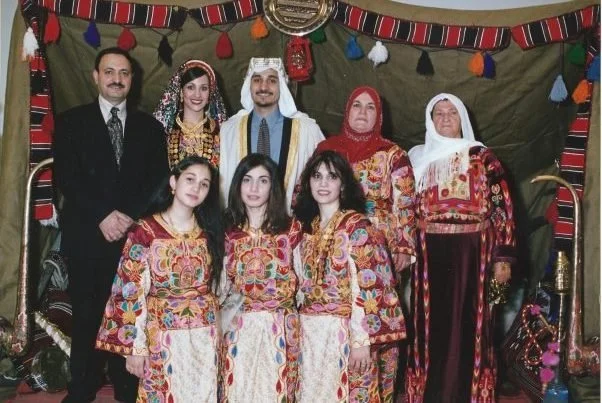
Rabeeha, a very secure, strong-willed, and mirthful first-generation immigrant is very proud to self-identify as Palestinian.
Born in 1951, Rabeeha faced the conflict between Israelis and Palestinians on a daily basis growing up in the city of Ramallah. Rabeeha immigrated to the United States in 1972 and continued to possess great pride for her Palestinian heritage. Rabeeha believes that traditional clothing is a tool to portray one’s culture.
The cultural clothing pieces she owns consists of cross-stitching, which is handmade in Palestine, and others which are made by machines. Rabeeha expresses that the traditional piece of clothing is called, “thob-al-philistini.” She also says that the thob is worn in special occasions such as weddings or for organizations. Rabeeha expresses that she feels proud and happy when she wears her cultural clothing, she says, “it’s the past-if you don’t have past you’ll never have future…that’s our roots, that’s our things, and we have to keep it alive.” Her past is crucial to her future and her cultural clothing allows her to keep her past alive. Rabeeha believes that the cultural clothing was influenced by religion in the past, but not as much nowadays. Her reasoning for that is the way the dresses are designed, they have long sleeves and cover the entire length of the body. Rabeeha’s mother always wore the thob back home and Rabeeha plans to pass it on to her children just as her mother passed the clothing on to her.
She believes it is important to pass on the cultural clothing because, “this way it will keep the tradition alive, and of course they will say oh that’s from my mother, it’s from my grandmother and mother, and it’s nice- and she will take care of it, and she will pass it onto her kids too. Yeah, I have one its small now and my daughter said, ‘Mom! That’s for my daughter –leave it!”
Cultural clothing is extremely special and meaningful to Rabeeha.
Naziha Asad
Naziha Asad, a first-generation immigrant from Palestine, expresses the importance of cultural clothing to her. She immigrated to the United States when she was 14 years old in 1968. She was born in 1952 in Al-Bireh, a town in Palestine. The war in Palestine caused her father to decide to leave Palestine and take Naziha with him because she could read and write. Naziha explains that at the time it was difficult to enter the United States if you were illiterate, therefore, her father took her along with him to assist in the literacy portion and ease their journey.
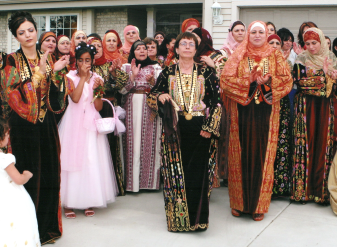
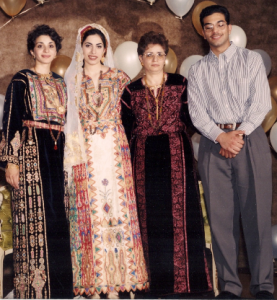
Naziha in the center of both pictures wearing a thob & gold when picking up the bride, prior to putting on the headscarf
She believes her father left Palestine because there were less job opportunities in a war zone and it was not a safe environment for his family to live. Naziha defines herself as an Arab- American. She recently began to wear the headscarf on a daily basis in the United States. Her reasoning for putting on the headscarf was the amount of shame she felt when strolling through the streets of Palestine without it on during a visit. Culture is of great importance to Naziha and she attempts to bring back her culture to the United States from her visits in Palestine through clothing. Although her mother wears the cultural clothing on a daily basis, Naziha only wears traditional clothing to weddings or other special occasions.
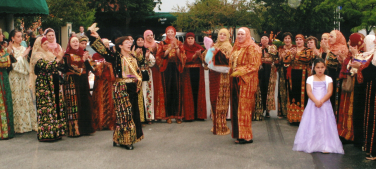
Naziha dancing with other women during her son’s wedding celebration
Naziha in a thob after putting on the headscarf
She expresses that many women wear gold jewelry with their thob, especially when they are relatives of the bride or groom. The cultural clothing she wears is called a “thob.” Naziha expresses, “you feel on top of the mountain” when she wears her thob. She describes that it is a beautiful feeling and look when she puts on her traditional clothing. Naziha states, “I feel very great and elegant with it.” Naziha loves her cultural clothing and believes it is important to pass it on to her daughters. She expresses, “It’s very important, because if I don’t wear it and then my daughters don’t wear it, then that cultural stuff is gonna die. So we try to keep it at least going for uhm weddings, and like on holidays.” Naziha wears the thob to preserve the traditions, which she does not want to die out.
Ruba
Ruba is a 23 year-old second-generation immigrant female who was born in the United States. She identifies herself as American Palestinian and spent a portion of her life living in Beitin, Palestine, where her parents are originally from. She greatly appreciates her parents’ style in raising her and her siblings. Ruba says that her parents’ open-mindedness and understanding gave her the freedom and support to choose her career independently. Ruba expresses what cultural clothing means to her. She states that she owns a few pieces that her mother has bought her and she only wears her cultural clothing on the day before the wedding, which is called a “henna.” She explains that on the “henna” she wears a clothing piece called a “thobe” which is very traditional and most women wear gold with it.
Ruba expresses, “It’s nice to have that Palestinian identity, it’s nice to have that tradition. It’s nice to carry on the tradition after so many years, too.”
Ruba is proud to wear her “thobe” because it symbolizes to others that she identifies as Palestinian. In addition, Ruba is sure that she will pass her cultural clothing pieces on to her children in the future.